Mount Kailash, also known as Kangrinboqê or Gang Rinpoche, is one of the most sacred mountains in Asia. Revered in Hinduism, Buddhism, Jainism, and the Tibetan Bon tradition, it has inspired centuries of pilgrimage, stories, and speculation. Its summit has no confirmed recorded ascent, and climbing is prohibited by Chinese authorities.
This article revisits ten popular claims about the mountain: which have a factual basis, which are matters of belief, and which are unsupported or misleading.
1 The height of Mount Kailash

Claim: “Mount Kailash is one of the world’s most mysterious places, and its height is exactly 6,666 meters.”
The commonly cited elevation of Mount Kailash is 6,638 meters (21,778 feet) above sea level. The figure 6,666 meters is not the standard elevation given by geographic references. You may encounter different measurements in older or secondary sources, but that does not establish a hidden or mysterious height. The number 6,666 is often repeated in popular stories because of its symbolic associations, not because it is a verified measurement.
2 Is Easter Island on the opposite side of Earth?
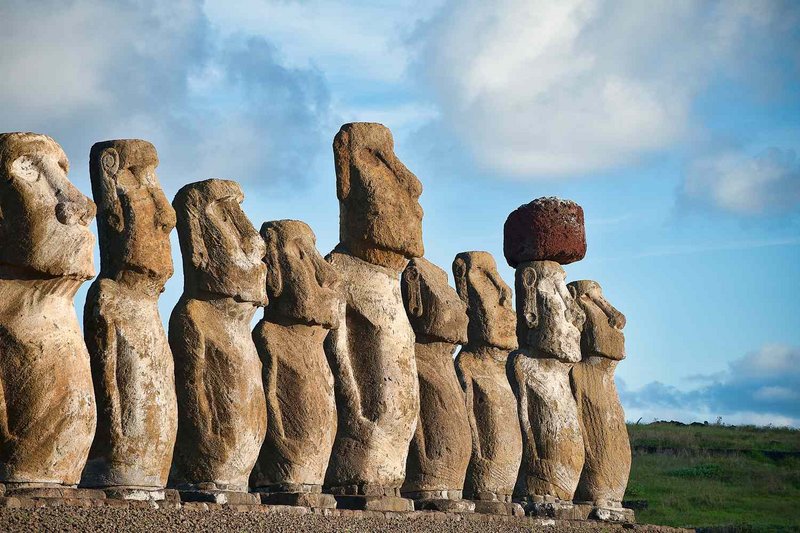
Claim: “Easter Island, famous for its stone statues, lies directly opposite Mount Kailash on the other side of Earth.”
The point directly opposite a place on Earth is called its antipode. It can be calculated by reversing the latitude and shifting the longitude by 180 degrees. Mount Kailash’s antipode is in the South Pacific Ocean, not on Easter Island. Easter Island is also in the South Pacific, but it is not the exact opposite point.
So the claim has a kernel of truth only in the broad sense that both locations are in the Pacific region of the globe’s opposite hemisphere. They are not a precise antipodal pair.
3 Do people age faster near Kailash?
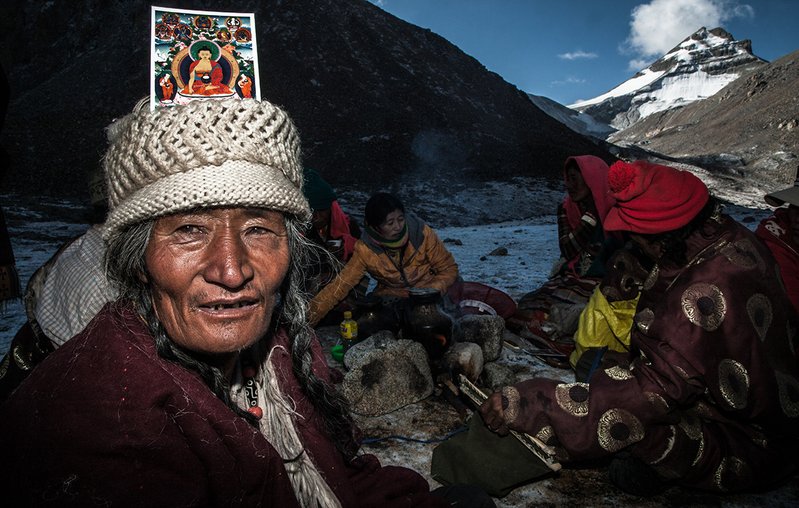
Claim: “People near Mount Kailash age faster: twelve hours there are equivalent to about two weeks, as shown by the growth of hair and nails.”
There is no reliable scientific evidence that time passes differently for people near Mount Kailash or that they age faster there. Hair and nail growth is affected by several factors, including age, health, nutrition, and season. Cold conditions generally do not provide evidence of accelerated aging; they can affect normal bodily processes and may make changes in hair or nails seem more noticeable.
The “twelve hours equals two weeks” story is an extraordinary claim without credible measurements or published evidence to support it.
4 Has Mount Kailash never been climbed?
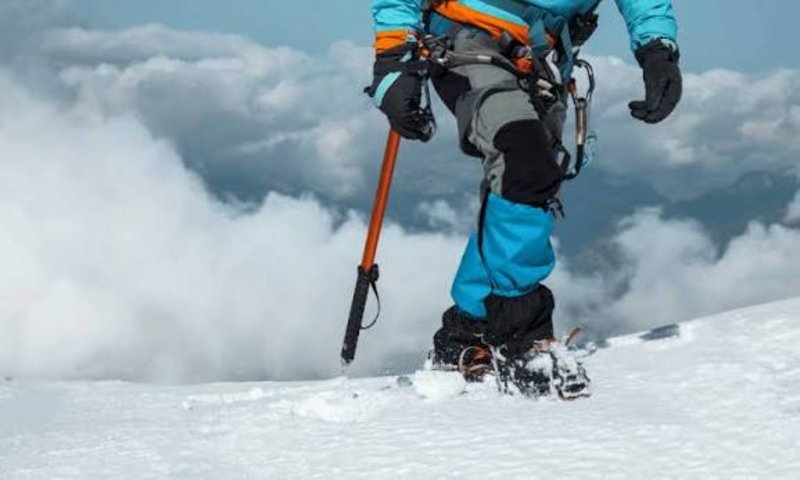
Claim: “No climber has ever reached the summit. The mountain throws back anyone who tries, and religious texts say that anyone who sees the gods there must die.”
There is no confirmed recorded ascent of Mount Kailash. But that does not verify supernatural stories about the mountain physically rejecting climbers. Its religious significance is a central reason it is left unclimbed, and Chinese authorities have prohibited climbing there since 2001.
A frequently repeated account says that a Spanish expedition received permission to climb the peak in 2001 and then withdrew after protests from religious communities and public figures. The details of the reported permission have been disputed; Chinese authorities said climbing activities were prohibited. It is more accurate to describe this as a reported permit controversy followed by a clear prohibition, rather than as a successful expedition turned back by the mountain.
5 Is it forbidden to touch or swim in Lake Rakshastal?

Claim: “Lake Manasarovar is a sacred freshwater lake where the water is calm in every season, while salty Rakshastal is a lake of ‘dead water’ that must not even be touched-and is always stormy.”
The two lakes near Mount Kailash do differ. Manasarovar is a high-altitude freshwater lake and an important pilgrimage site. Rakshastal is saline, so its water is not suitable for drinking. In religious traditions, the lakes may also carry contrasting symbolic meanings.
But claims that Manasarovar is always calm and Rakshastal always stormy are not reliable descriptions of weather. Conditions vary. Nor is there scientific evidence that merely touching Rakshastal’s water is dangerous because it is spiritually “dead.” Its salinity is a real physical property; the prohibition on contact is a matter of belief and local custom. Visitors should follow local guidance and avoid swimming in remote, cold, high-altitude lakes, where conditions can be hazardous.
6 Does the mountain display a swastika?
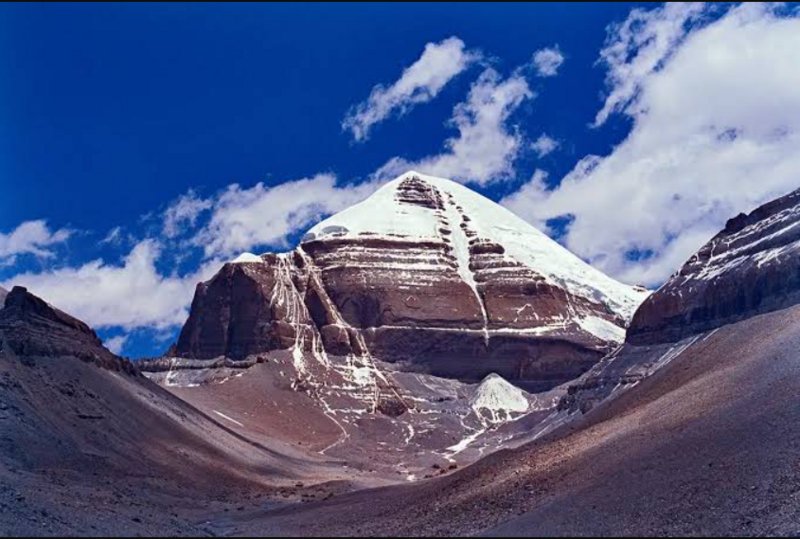

Claim: “Two huge ridges or cracks on Mount Kailash form a giant swastika, especially when evening shadows fall across the rock.”
The mountain’s ridges, gullies, snow, and shadows can create striking patterns, and some viewers interpret one arrangement as a swastika-like shape. However, there is no evidence that the mountain was deliberately shaped to form this symbol. The appearance depends on viewing angle, lighting, and how the eye groups natural features.
It is also worth remembering that the swastika is an ancient religious symbol used in several Asian traditions, including Hinduism and Buddhism. Its meaning in those contexts is distinct from its later appropriation by the Nazis.
7 Is Mount Kailash a pyramid?
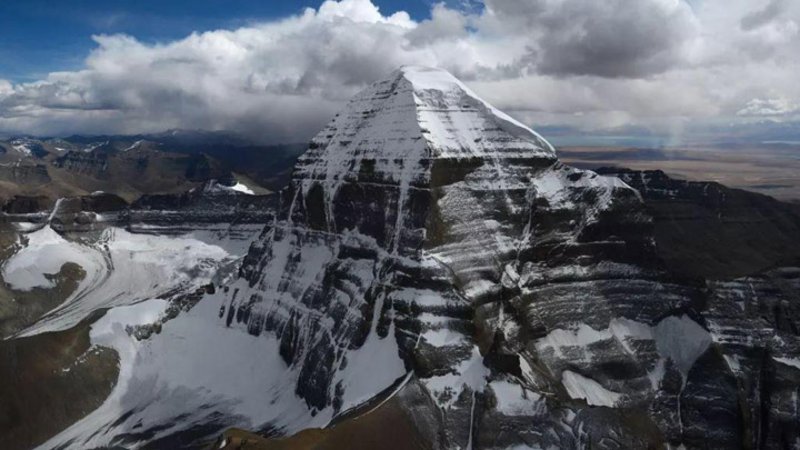
Claim: “Mount Kailash is actually a pyramid, aligned precisely with the cardinal directions. Scientists who have visited it supposedly agree.”
Mount Kailash has a distinctive, roughly symmetrical profile that can look pyramid-like from certain viewpoints. But a mountain that resembles a geometric shape is not necessarily an engineered structure. There is no established scientific consensus that Kailash is a pyramid, and the claim that visiting scientists universally agree with it is unsupported.
The mountain is a natural peak in the Gangdise (Transhimalaya) range. Its striking shape can be discussed without treating visual resemblance as proof of artificial construction or precise alignment.
8 Was the mountain built artificially?
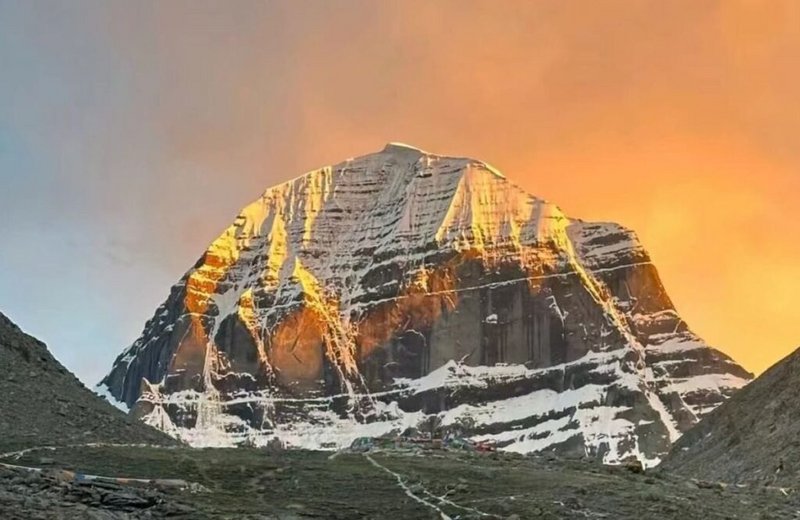
Claim: “Many scientists believe Mount Kailash is an artificial structure with hollow chambers inside, built by an unknown civilization for a specific purpose.”
No credible geological evidence has been presented to show that Mount Kailash is an artificial construction or contains the alleged engineered chambers. The claim is sometimes repeated in mystery-themed accounts, but those accounts do not provide verifiable research, named studies, or documented survey results.
The evidence-based description is straightforward: Kailash is a natural mountain. That conclusion comes from its geological setting; it does not require proving or disproving every unverified story about hidden spaces inside it.
9 Is Stonehenge exactly 6,666 kilometers away?

Claim: “Mount Kailash is 6,666 kilometers from Stonehenge, 6,666 kilometers from the North Pole, and twice 6,666 kilometers from the South Pole.”
These precise-looking distances depend on which points are measured, what route or distance method is used, and how the figures are rounded. The numbers are not evidence of a hidden global design. A straight-line distance on the Earth’s surface is not the same as a route distance, and a measurement chosen after the fact can produce coincidences that seem meaningful.
The original claim offers no clear measurement method or reliable source for its repeated 6,666-kilometer figures. Without those details, it should not be presented as an established geographic fact.
10 The “Nandi Sarcophagus” and the sages inside

Claim: “A structure beside Mount Kailash called the Nandi Sarcophagus contains hollow chambers where the world’s great spiritual teachers-including Jesus, Buddha, Krishna, Zoroaster, and Confucius-remain in deep meditation. They are supposedly preserved there to continue humanity after a civilization-ending catastrophe.”
This is a modern esoteric story, not a verified archaeological discovery. The claim does not provide independently reviewable research, excavation records, or reliable evidence that such chambers contain people in a state of meditation. Nor is there credible evidence for the story that these figures are being preserved as a future human gene pool.
The nearby landscape includes natural rock formations that have been given religious and cultural interpretations. Those traditions can be described respectfully, but they should not be confused with scientific proof of a hidden sarcophagus or its alleged occupants.
Conclusion
Mount Kailash does not need invented measurements, secret chambers, or supernatural explanations to be remarkable. Its unusual profile, remote setting, importance to several religious traditions, and lack of a confirmed summit ascent already make it a distinctive place. The most useful way to approach its “mysteries” is to separate documented geography and history from sacred tradition, personal interpretation, and claims for which reliable evidence has not been produced.